|
Yao People profile
|
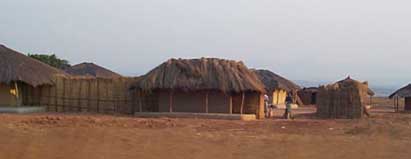 |
| The Yao are a predominantly Muslim people group of about 2 million spread over three countries, Malawi, Mozambique and Tanzania and are one of the poorest people groups in the world |
|
Historical Background
|
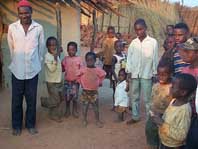 |
The Yao have lived in northern Mozambique for hundreds of years. A close look at the history of the Yao people as a whole will show that their ethno geographic center is located in a small village called Chiconono, in the northwestern Mozambican province of Niassa. |
| When Arabs arrived on the east coast of Africa they began trading with theYao people, mainly slave and ivory, in exchange for clothes and guns. Because of their involvement in this coastal trade they became one of the richest and most influential tribes in Southern Africa. Large Yao kingdoms came into being as mighty Yao chiefs took control of the Niassa province of Mozambique in the 19th century. During that time the Yao began to move from their traditional home in today's Malawi and Tanzania, which resulted in the Yao populations they now have. |
| The most important result of the great chiefdoms was the turning of the whole nation to Islam around the turn of the 20th century and after the 1st World War. Because of their trade with the Arabs, the Yao chiefs (sultans) needed scribes who could read and write Arabic. |
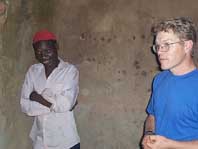 |
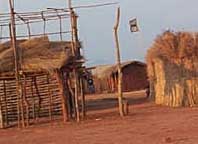
| The Islam teachers who were employed and lived in the Yao villages, made a significant impact on the Yao people because they could offer them literacy, a holy book, smart clothes and a square, instead of round, houses. |
 |
Furthermore, the Yao sultans strongly resisted the Portuguese, British and German colonial rule, which was viewed as a major threat to them. The British, who were seen as Christians, tried to stop the slave trade by attacking some of the Yao slave caravans near the coast. |
| They freed the slaves and confiscated the ivory, which the slaves had been transporting. The greater Yao chief Mataka decided that becoming a Christian would have a negative economic impact on his people, while Islam offered them a social system, which would assimilate their traditional culture. Because of the political and ritual domination of the chiefs, their conversion to Islam caused their subjects to do likewise.
The Islam, which they have embraced, is not the orthodox religion, which is found in the countries such as Iran, Iraq, Saudi-Arabia, ect. But is totally intermingled with their traditional animistic belief system. It is often referred to as "Folk Islam"
|
|
The Yao of Mozambique
|
The Yao people have a strong cultural identity, which seems to transcend the national borders. It is necessary to take note of the following set of circumstances, which have occurred in Mozambique's history:
- Nearly 500 years of Portuguese rule and influence
- The long bloody struggle during the war of independence (1962- 1975)
- Over a decade of Marxism under the leadership of Mozambique's first president, Samora Michel.
- The effects of 17 years of civil war, famine and disease resulting in millions of deaths and Mozambique. (1975 - 1992).
|
|
Population and Location:
|
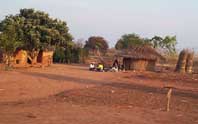 |
There are a minimum estimated 450 000 Yao people living in Mozambique. They largely occupy the eastern and northern part of the Niassa province and form about 40% of the population of Lichinga, the capital of this province. |
|
Christian faith:
|
| Recent information estimates that a mere 0,02 % of the Mozambican Yao people is Christians. The majority of the Mozambican Yao people are virtually ignorant of who God is, how creation happened and the need for a savior. They need certain knowledge of the Old Testament first in order to help make sense of the New Testament message of Christ.
Presently there is New Testament translation in Yao. However, for the most part, the Yao have rejected it because it is considered and inferior translation. A new translation in underway in Malawi. It is hoped that this translation will be understandable for the Mozambican Yao people as well. |
|
Livelihood
|
 |
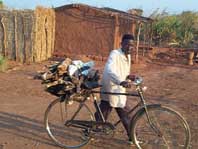 |
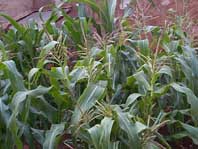
| The Mozambican Yao people are generally agricultural. Growing a good corn crop has everything to do with how a given family makes a living. Their level of production is mostly subsistence and therefore they basically eat what they grow. When a good corn crop is produced they sometimes will sell some of it on the local market in order to buy things that they do not produce themselves such as soap, salt and bicycles. |
