ALIGNING STAFF DEVELOPMENT WITH BASE GOALS
Imagine a base that got so absorbed in ensuring adequate transport for outreaches that the whole focus of the base eventually swung to vehicle acquirement and maintenance. Any visitor would recognize that the team had lost their focus for reaching the lost with the Gospel. But aren’t vehicles important? Yes – but they serve the focus of evangelism and church planting. In the same way staff development is meant to serve the goals and objectives of the base, not to become the focus of the base.
“Strategic human resource development (SHRD) means the process of changing an organization, stakeholders, outside it, groups inside it and people employed by it through planned learning so they possess the knowledge and skills needed for the future.”
“Experience denotes awareness based on participation in past problem-solving…”Many people believe that 95% of all learning occurs through experience.” 155
Strategic human resources management 166-167
· Strategic tasks
· Strategic technology
“The HRD effort is used to support implementation of organizational and HR plans and is driven by those plans.” 183
Table 15.4 Types of training offered to self-directed work teams 398
|
Types of Training |
% of responding companies that offer each |
|
Problem solving |
83 |
|
Meeting skills |
65 |
|
Communication Skills |
62 |
|
Handling Conflict |
61 |
|
SDT roles and responsibilities |
58 |
|
Quality tools and concepts |
56 |
|
Evaluating team performance |
39 |
|
Work flow and process analysis |
36 |
|
Selecting team members |
35 |
|
Presentation skills |
35 |
|
Influencing others |
29 |
|
Budgeting |
14 |
FIGURE 14.1 The experiential learning cycle 361
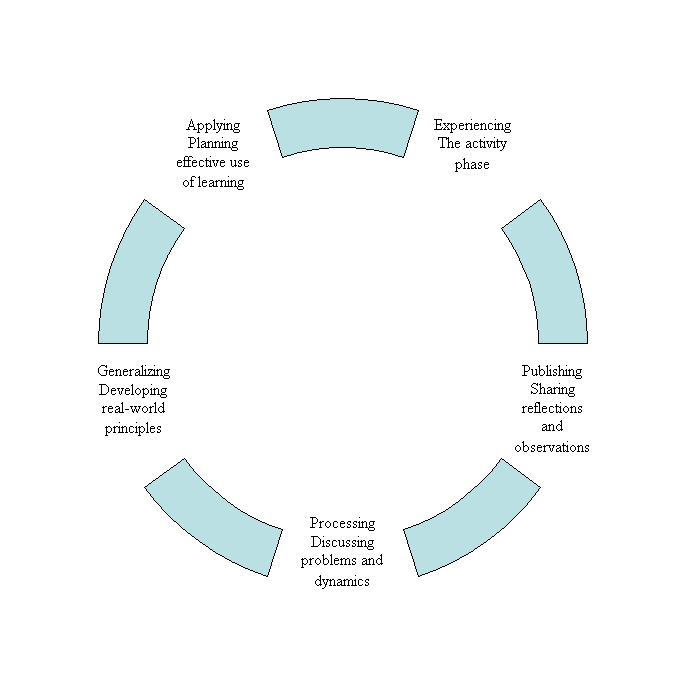

Table 5.2 Scales and sub-scales of the Team Climate Inventory (source: Anderson and West 1994a)
|
Scale |
Sub-scale |
|
Participative Safety |
Information sharing |
|
|
Safety |
|
|
Influence |
|
|
Frequency of interaction |
|
Support for Innovation |
Articulated support |
|
|
Clarity |
|
|
Perceived value |
|
|
Sharedness |
|
|
Attainability |
|
Task Orientation |
Excellence |
|
|
Appraisal |
|
|
Ideation |
|
Social Desireability |
Social aspect |
|
|
Task aspect |
Hayes, Nicky. (1997) Successful Team Management. London: International Thomson Business Press. p. 124.